
Functional Thoughts
Beyond the Infographic: About Our Paper on Dog Body Shapes

Nov
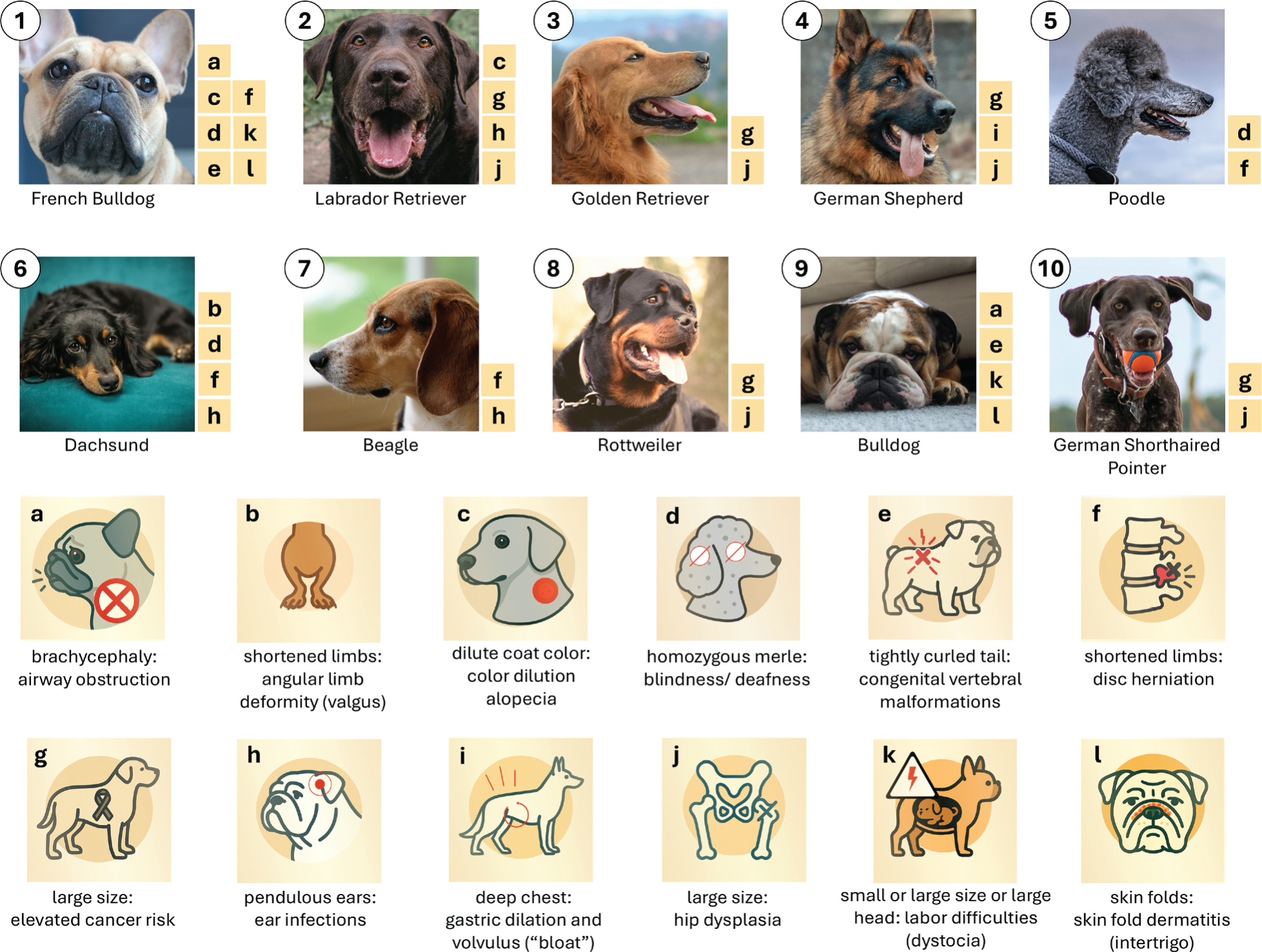
We are glad our new paper, “Extreme morphologies compromise canine health and welfare and require evidence-based breeding reform,” has been reaching so many people, and thought it would be a good time to explain our goals in writing it. For those of you who just saw the infographic (aka figure 2), there’s a lot more going on in the paper than you might realize just from that. The paper itself is open access, and we paid extra to publish it that way because it’s important to us that it be available to everyone – so we encourage you, if you have concerns about it, to read it!
First, we wrote this paper not to disparage breeders or purebreds, but to help breeders make dogs healthier. We are worried about some of the messaging we see directed at breeders, which often seems to focus on completely avoiding certain characteristics (while ignoring others that are also problematic) without suggesting an alternative way forward. Flat-faced dogs get a lot of attention, and some countries are considering bans on some breeds. We suggest a better approach than simple, outright breed bans is to study how short a muzzle can be without creating risk of BOAS, and how breeders can get from here to there.
Note that this is a review paper – we didn’t go measure all these welfare issues ourselves. We read a lot of papers (many more than the 100 we had room to actually cite) and wrote a summary of what we found. We particularly focused on mechanism, meaning that whenever the link between a disorder and morphology is deeply understood, we explained it. This paper is really the work of many, many researchers who all care about canine welfare – and to show that, we have signatures from many of them (as the Canine Morphology and Welfare Working Group authors) saying that they agree with the conclusions. In other words, it isn’t just the Hecht Lab saying all this.
Here are some answers to some frequently asked questions about figure 2:
- Why did you include merle in poodles and dilute in labs, since those colors aren’t allowed in the breed standards?
- Those colors are, however, seen in significant populations of those dogs, and have been for decades. We aren’t just talking to show breeders here; we are talking to other groups, who may produce off standard dogs, as well.
- X breed wasn’t described in figure 2 as having Y disorder even though that breed commonly has Y.
- This infographic wasn’t meant to be comprehensive. It was meant to get people thinking about how common morphology-based welfare issues are. Particularly, we focused on mechanisms – so for example we included big dogs as being at risk for hip dysplasia due to size, and not small dogs who are at risk for less well understood reasons.
- The disorder you listed in the infographic isn’t a big deal. In fact, it can be easily treated.
- Problems that can be treated are less significant than those that can’t, of course, and we all have to make our own decisions about which of these issues are worth breeding away from. We argue that ideally a dog should be healthy without having to have treatments. No dog is going to have zero issues, but we hope people will discuss the merits of breeding away from those that we can in fact control. Finally, our goal was not to list only the most severe, but to get people thinking about how common morphology-based disorders are.
- For example, the ridge on the back of Rhodesian Ridgebacks is produced by extra copies of three genes involved in cell growth and tissue repair. Unfortunately this mutation is associated with risk of developing dermoid sinus, which is a disorder in which the skin does not separate properly from the nervous system during development. Dermoid sinus can lead to infection of the brain and/or spine and produce neurological problems. It occurs in about 5% of Rhodesian Ridgeback puppies. While this developmental disorder can sometimes be treated with surgery, it is not always curative. The risk for dermoid sinus can be greatly reduced by breeding heterozygous dogs (which still have a ridge) with ridgeless dogs. This is a simple step to improve health in the breed, which does not require eliminating the desired physical trait from the gene pool.
- It’s irresponsible breeding that causes these issues, not the breed itself.
- We want to help guide less responsible breeders towards being more responsible. Having research showing true physical trait-disorder links, versus false ones, helps responsible breeders know what to select against.
We hope you will take the time to read the paper, and encourage you to discuss questions about its contents here and among yourselves. It is meant to get people thinking about how we do and could manage the breeds that are such an important part of our lives.
Cross posted to the Canine Brains Project.