
Podcast
Breeder Spotlight: Laura Sharkey and the Bosun Dog Project
Jul
Jess Sedivy (00:00)
Welcome to the Functional breeding podcast. I’m Jess Sedivy Gunderson, filling in as interim host for Perry while she is on a break.
The FDC podcast is here to explore what goes into breeding dogs for functional health, both behavioral and physical. This podcast is brought to you by the Functional Dog Collaborative, an organization founded to support the ethical breeding of healthy, behaviorally sound dogs. The FDC provides educational, social, and technical resources to breeders of both purebred and mixed breed dogs.
You can find out more at functional breeding.org or in the functional breeding Facebook group, which we work very hard to keep friendly and inclusive. If you would like to support the podcast, you can find us on Patreon. There will be a link in the show notes.
Today we’re welcoming back Dr. Laura Sharkey—trainer, breeder, and founder of the Bosun Dog Project. Laura has been on the podcast before, most recently she had a conversation with Perry about what puppies are capable of. If you haven’t listened to that most recent episode, we highly recommend going back for a listen before continuing with this one.
In this episode, we build on that foundation and ask Laura: what has evolved in her program overall? We talked about her most recent litter of puppies, what she learned whelping almost 25 litters of foster puppies before deciding to breed her own dogs and the importance of mentorship and transparency in the breeding community. I hope you enjoy listening to this episode as much as I enjoyed recording it.
Laura, thank you for joining me today. The FDC community loves hearing from you and about your Bosuns. Last time, you and Perry talked quite a bit about what puppies can learn, even at a very young age. Thinking back to that conversation from last July, how are the puppies from that litter doing?
Laura Sharkey (02:12)
They’re fantastic. actually ⁓ just got a message from someone saying, hey, haven’t checked in for a while, but we’re totally in love with this dog. Everything’s going well. So, and that’s pretty much the last two litters. ⁓ the dogs are very, well.
Jess Sedivy (02:28)
Cool, did you have any surprising outcomes, anything unexpected that maybe exceeded your expectations?
Laura Sharkey (02:34)
All of them have exceeded my expectations because we’ve had some issues in the past, which, you know, obviously we’re breeding away from a few different things. And I’m very, very pleased with the last two litters
Jess Sedivy (02:46)
That’s wonderful. It’s always fun to get all that positive feedback. Yeah.
Laura Sharkey (02:49)
Yeah, yes, it’s amazing. It’s so amazing.
I’m really excited. Now my problem is how to keep repeating that.
Jess Sedivy (02:56)
Exactly, now the bar keeps creeping up.
Laura Sharkey (02:59)
Yeah, well, and also
like for me, I breed, you know, I outcross constantly. And so one of the problems with my breeding program is how to breed to type without inbreeding, right, which is a lot of the problem with this kind of program.
Jess Sedivy (03:12)
Yes. Exactly. Yes.
And that’s something I really want to dig into with you. ⁓ Yeah, definitely. So that’s OK. And I think it’s OK to talk about how we how we don’t really have those answers. And that’s, think, one of the most fascinating things about talking to breeders.
Laura Sharkey (03:20)
yeah. I have no answers, just FYI.
Yeah.
Jess Sedivy (03:34)
So, you know, one of the things that comes up a lot just in
Functional Dog Collaborative is this
this discussion of function. And so when you’re out when you’re out crossing all the time and you’re not breeding to type, like you said, what are some of the things that you evaluate on a litter by litter basis
to help build a functional dog?
Laura Sharkey (03:56)
actually evaluate my adults when thinking about function. I’m thinking about that with like the adults that I’m going to breed because I’m trying to think about like, are these puppies gonna grow into and are they gonna grow into a functional adult? One of the things I’m really pleased about is that my foundation girl, Zephyr, who’s nine now, is
in incredible health. She’s still fast. She still jumps on like from the floor onto the desk with no problem despite rules against such behavior. ⁓ She’s happy. She’s fit. She’s healthy. She has lost some hearing, which is a little bit of a concern, ⁓ but overall she’s super fit at nine. We just took her
with us to clicker expo and she was awesome. fit to me is a dog who’s not limping or, you know, can still run, can still jump off on and off the bed and can still do sports, you know, to their age level. So I’m always, I’m evaluating my adults more than anything.
And even my one and two year olds, I wanna once they’re out of their puppy and into, through most of adolescence, how are they behaving? How are they moving? I really, longevity and health into longevity is really important to me. I don’t want a dog who at nine years old is
not moving well, you know? So for me, that’s what I think about with fitness. come across so many people and dogs in my training and daycare practice. And find people tend to think of a nine or a 10 year old dog as like ancient and done.
Jess Sedivy (06:01)
Yes, I agree. That’s something that has always stunned me about Retrievers too
Laura Sharkey (06:04)
Yeah!
And mean, Zephyr’s nine and I am like, what are you… But so many dogs are overweight.
So many dogs have ⁓ joint problems, right? And so for me, that’s my definition of fitness and function. Can the dog move? Can the dog do what they want and what I want? ⁓ And that’s the physical function, right? Which is really quite separate from their emotional function.
Jess Sedivy (06:16)
Yes.
Right, yes.
Definitely. Yeah
Laura Sharkey (06:38)
which
is different. So you have to define what function are you talking about.
Jess Sedivy (06:43)
Yes exactly and it’s always fascinating to me how they tie in together and to make to make a complete dog and so one thing that i think is so interesting about your project because i come from the purebred realm where we are breeding dogs for. things and usually a specific purpose we’re also breeding dogs to be companions but but they are purpose driven and so i find your project to be.
Laura Sharkey (06:48)
Yes. Yes.
Jess Sedivy (07:13)
somewhat liberating in the sense that you can prioritize just companion temperament above everything else and i was just wondering if you could talk a little bit about your process and your evolution on that and kind of what started you to think about the modern world and how companion dogs fit in into that modern world.
Laura Sharkey (07:20)
Yes.
So being a companion is a purpose, right? And if you look at the number of dogs in the United States, what percentage of them…
Their purpose is a companion, right? I would say, I don’t know, 90%, something like that, I. So I’m a dog trainer and I ran a dog daycare for 24 years. We just closed it the other day. And so I meet pet people. I meet nothing but pet people, right? And I’ve met so many pet people who have gotten a dog.
and it’s just not working out for them as a companion for whatever reason. They got a border collie and they live in the city or they got a rescue and it’s fearful or whatever. And so I started thinking, wow, these families can’t find the right dog for them, whether in the purebred world or in the rescue world. And I was like, I could breed them a dog.
that would work for their family. Like, why not try that?
Jess Sedivy (08:48)
Absolutely. Yeah.
Laura Sharkey (08:50)
And that’s where I came from. It was my clients who were looking for a dog who adopted a dog or purchased a dog and it didn’t work out. It was heartbreaking. There were tears. A lot of times there are children involved and that’s even worse. It’s so hard on kids to understand why they may or may not be able to keep a dog or why the dog doesn’t like them or whatever. And so that’s what spurred me to start thinking about like…
I’ve had a lot of great companion dogs in my time. I’ve also had a few aggressive, really challenging dogs in my time. And so I just thought, know, wow, what if I could breed these people a dog? I know what they need. I know what they want. And I don’t know, let’s just go for it.
in its most simple form, I was thinking like, what if I bred a really nice dog to a really nice dog? Would I get really nice dogs?
Jess Sedivy (09:47)
Exactly.
Laura Sharkey (09:49)
of course you, there’s so much more than that, but like at its basis, like the base thought was, I breed to get a nice dog and breed it to a nice dog and get a nice dog? And that’s what I’ve been trying to do.
Jess Sedivy (10:07)
love that and sometimes I feel like we over complicate some things with breeding and sometimes it is enough to breed a nice dog to a nice dog and you get absolutely wonderful results and are there any traits when you when you’re assessing a dog for companion temperament are what kind of traits do you prioritize
Laura Sharkey (10:28)
it’s interesting you ask, cause I am in the process of looking to add dogs to my program. I depends on either way, if it’s a puppy or an adult, I want a dog that runs up to me, approaches me enthusiastically and happy, right? That’s the first thing I want. ⁓ the second thing I want is a dog who doesn’t
need my constant attention, right? So I want them to run up to me and say, hi, how are you? And then I can pet them or throw a ball. But once they meet me, they’re not like on my head, you know? So, you know, I want an affiliative dog, but not an incredibly needy dog.
Jess Sedivy (11:11)
I do.
think that makes a lot of sense.
Laura Sharkey (11:20)
You
know, I want a dog with an off switch. I want a dog that can lie down and do nothing. But if I grab the ball or whatever gets that dog going that they’re up and ready. Right. And again, this is just temperament wise. I’m not even you know, we’re presuming we’re already talking about.
healthy dog, a dog without a history of, you know, any genetic diseases and stuff like that, because obviously that’s first. But those are two of the things I’m looking for. I want a dog that doesn’t, you know, guard from people for sure. You know?
Jess Sedivy (11:44)
Correct. Yes.
Laura Sharkey (11:58)
I don’t know, I have a list of like really like things that I’m looking for.
Jess Sedivy (12:04)
So tons of thought that has gone into it.
Laura Sharkey (12:06)
tons
of things, but when I meet a dog, those are the first things I want to know. I want a dog that comes up to me and greets me politely and enthusiastically. Yeah.
Jess Sedivy (12:14)
I love that.
Over time, over kind of the arc of your breeding experience, are there any traits that you used to think were really important that you’ve somewhat de-emphasized as time has gone on? Or have you just continued to add things you feel are important?
Laura Sharkey (12:32)
Well, my breed used to be a border collie. And at one point we had three border collies and a Bosun dog. The first Zephyr. And now we have one border collie and three Bosun dogs and life is so much easier. and Zephyr, our foundation girl is half border collie, half But bringing in a less intense dog,
our norm had shifted to the intensity of the Border Collies. And then we brought in Zephyr and we were like, she’s so much easier. And as the Border Collies grew older and passed on, we now have our last remaining Border Collie. And as much as I love a Border Collie, I’ll never go back. The Bosons are just too easy.
Jess Sedivy (13:10)
Mm-hmm.
Laura Sharkey (13:24)
because they’re there when you wanna do something with them, but they’re cool if you don’t. And so I think what I thought I liked about the intensity turns out I don’t like it as much as I thought I did.
Jess Sedivy (13:40)
Fascinating. One other question I had thought of, because you are free from a breed standard or any type of structure, and I’ve noticed as I’ve gotten older and I talk to people, potential puppy homes, are there discussions that you have about size of dogs? I do feel like I encounter many people who are looking for.
a dog that’s a little bit more moderate or medium or smaller. Is that something you ever think about?
Laura Sharkey (14:11)
Yes, I think about it and I usually dismiss it. Yeah, you know, so I wanna breed a dog that’s between 30 and 60 pounds. And so…
Jess Sedivy (14:16)
Perfect.
Laura Sharkey (14:29)
If all my other boxes are ticked and then I have a choice between a 60 pound dog and a 40 pound dog, I would choose the 40 pound dog. But I have found it is way too hard to get everything else that is more important to me that I have not come across a situation where I have five.
perfect dogs that I could breed to and I can pick the size that I want. That hasn’t happened for me yet. So
Jess Sedivy (14:54)
you
Laura Sharkey (15:01)
do have that in my mind and I find that I don’t have the liberty yet to make that an important part of my component. And I know people want a certain size dog, but I will say that once people get
one of my dogs and maybe they end up bigger than they expected, they don’t care because the dog is so wonderful. So I don’t feel like it matters that much.
Jess Sedivy (15:33)
So this is an interesting piece too of the work that you do. When you breed purebreds, it’s a little bit easier to talk to potential puppy homes about predictability and about expectations. And so I’m really curious to know how does that process look for you when you are talking to prospective homes and you have things like size that you can’t
Really predict and so how do you talk through with people. Expectations for a dog when you’re pretty confident that you’re gonna be breeding dogs who have really nice companion temperaments but you’re not as confident about the rest.
Laura Sharkey (16:17)
Yeah, you know, and another thing that’s really interesting is coat. People wanna know what the coat is too, and I also have no idea what their coats are gonna be
Jess Sedivy (16:20)
Yes.
Laura Sharkey (16:24)
So people care about those two things, and I don’t. And so I just tell them, I just tell them, I tell them that the dog will be between 40 and 60 pounds.
Jess Sedivy (16:30)
Yep. And so how that’s great though, because it’s fun to how you balance it.
Laura Sharkey (16:42)
And I tell them their coat might need grooming or it might shed. I’m not sure either. You know, everybody asks me this and I just don’t, I don’t have a problem with it. It’s not a problem. People are like when they’re, cause almost all my puppy owners come to visit and meet the puppies and they don’t care. I tell them you might get this big. They’re like, yeah, that’s fine. Tell them.
You might have to groom him, you know, three times, four times a year. And they’re like, yeah, that’s okay. We’ll figure it out. Maybe because they, because the people who are coming to me already know it’s a mix. Maybe they don’t even have those expectations to begin with. So I don’t have to disabuse them of an expectation that doesn’t exist. You know, ⁓ plus the puppies are darn cute. And you know, like, you go to just look at a puppy and you end up taking one home.
Jess Sedivy (17:24)
Hahaha
Right.
Yeah.
Laura Sharkey (17:35)
Once they see it, they fall in love, they don’t care. You know?
Jess Sedivy (17:39)
I’ve always
found that too. I think, I sometimes wonder if we have culturally conditioned, more educated puppy buyers to think about certain things and care about certain things. And then once they get in and talk to a breeder and meet dogs, they realize that some of those things don’t really matter to them. And that is kind of, I don’t know, that’s just something that I kind of think about too.
Laura Sharkey (18:00)
Right, maybe.
Jess Sedivy (18:05)
One of the things people really, really respect about your approach to breeding is how thoughtful you are about raising your puppies and all of the years of training and behavior expertise you have. So I was wondering if you could just review a little bit for people. I know, I think this has come up in some of the previous episodes that you’ve been on, but if you could just talk a little bit about what your current puppy raising process looks like on a day-to-day basis, I think that would be interesting to people.
Laura Sharkey (18:31)
First of all, I have three people involved. It’s not just me. My wife Erica is involved and we have our pup pair extraordinaire who comes up from Florida, Jane Saunders, and helps us raise the puppies from three to eight weeks.
puppies, our Bosuns are being raised by three expert trainers and expert behavior people. We’ve all been doing this for over 20 years each.
means we see a lot. And we see a lot of really subtle things that maybe, you know, the average owner wouldn’t see.
But between the three of us, a couple of things happen. One is,
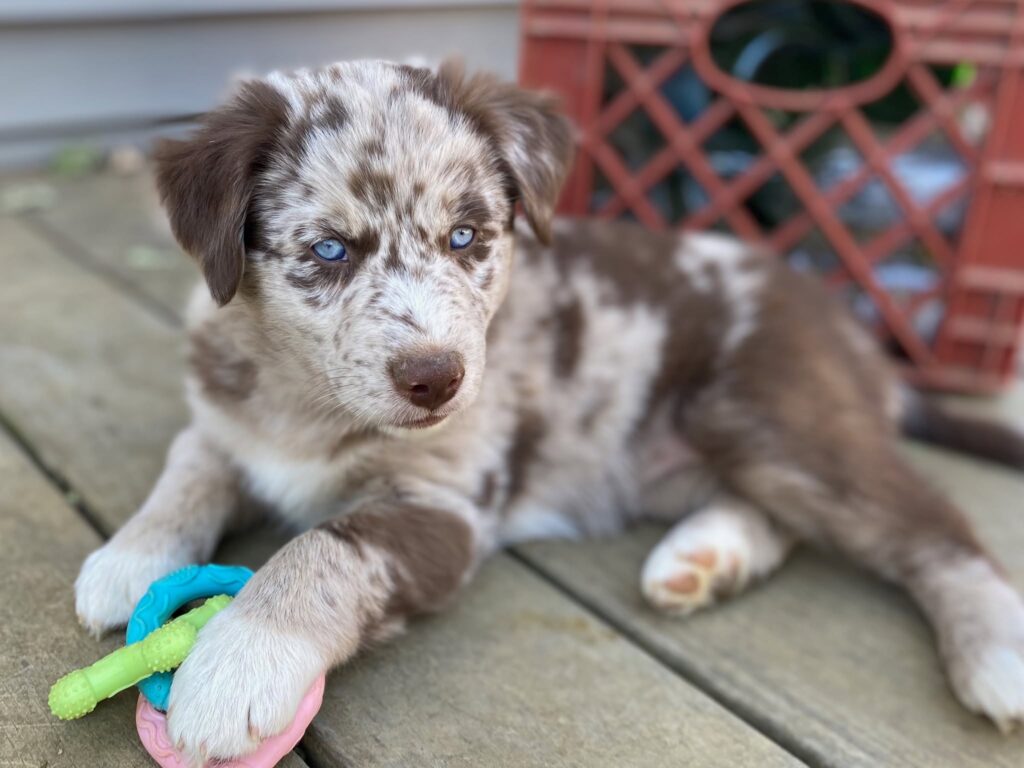
Somebody is always on puppy duty, right? And we all are in agreement about what we see. One of the things that has happened over the course of the litters is we do more with each litter because what I talked about in the last podcast is I just watched the puppies and every litter I was like, they’re so capable. And so we started giving them,
more and more and more freedom and it’s more and more and more work to be perfectly honest, right? You know, once they start climbing out of their whelping box, we don’t put a door on, we make the whelping box bigger. Because for me, if they’re climbing out, it means they’re ready to climb out. And I don’t want to do anything that
gets in the way of their growth and their exploration. So putting a door on is the opposite, you know? So as soon as they’re climbing out of the box, we’re like, okay, they’re ready for more. And what we do is we watch the puppies and we see what they do. We let them climb stairs whenever they want. And I know people like gasped at that. We’re right there, right? Anytime the puppies have access to stairs, there is somebody with them, right? They’re never accessed the stairs with.
Jess Sedivy (20:31)
Yes.
Laura Sharkey (20:34)
You know, we do keep them in a pen at night when they’re sleeping, but we let them do whatever they want. And when I see them doing something, I try to provide more of that. And it’s been crazy how much more they can do at really young ages.
Jess Sedivy (20:52)
I did think that your episode was fascinating and I think it’s really amazing when breeders can talk about how
They do look at the dog in front of them the puppy in front of them and they adjust and i’ve never. No one how to properly convey that to people to trust their instincts do you think that that’s something that you started to do overtime or were you always wired that way.
Laura Sharkey (21:04)
Yes.
did. So before I started breeding my own dogs, we raised ⁓ at least 25 foster litters for rescue and shelters. So they would either get a mom with very young puppies or a pregnant mom. instead of them being in the shelter, I had a boarding facility at the time and it was…
staffed 24 seven. So we would take these mom and puppies or sometimes just the puppies and we would raise them in
boarding
where all of the staff would go play with the puppies. Right. Once they got to be a certain age, we would put them in the lobby and all of our clients would pick them up or sit in the pen and play with them. And so while it wasn’t ideal in a home, it was better than in the shelter.
Right? We did so many things wrong. I had no idea anything about the whelping process. I mean, a little bit, whatever I read. And then in the, I’ve only bred six litters, but even in just the course of those six litters, we’ve changed everything. I mean, in
Jess Sedivy (22:08)
Absolutely, yes.
Laura Sharkey (22:28)
It used to be that every morning, like the pen was just covered in poop and pee and you’d like move all the puppies out. They’d need to be rinsed off. And then you’d scrub down the area because it was a mess. No, my puppies now are house trained by five weeks. Meaning it’s insane. I didn’t know that was possible. Like that’s one of the biggest things. I did not know that was possible until we started
Jess Sedivy (22:47)
Which is amazing.
Laura Sharkey (22:57)
watching puppies and seeing what they were doing. And over the course of the six litters, we’ve just done more and more. I’m not done yet. I think we can do more. Like I need another litter to go to the next step and find out more. But when we wake up in the morning, now granted we have three people doing this. So the puppies last out, is it like 1 a.m.? right?
⁓ so if we take Jane, Jane’s our night person, Jane takes them out at 1am, then somebody is up at 7. Right? So there might be one poop in the pen in the morning or two poops and a couple of little pees but it’s not a disaster. It’s not. They’ve been playing in it and running through it. It doesn’t happen because we’re taking them out so often. And one, my God, it’s delightful. It’s so much easier because it’s not disgusting.
I have a new theory on house training. I don’t think it’s training. I think it falls more into the socialization part of puppy development, not the training part of puppy development, because it’s something they do naturally is want to poop and pee elsewhere, right? That’s why crate training works, right?
Jess Sedivy (24:12)
Yes.
Laura Sharkey (24:13)
And so by providing this sort of thing earlier and earlier, it’s a natural instinct. We don’t have to train them. We only have to provide the circumstances. And so we are providing the circumstances earlier and earlier, and it just happens. It’s amazing.
Jess Sedivy (24:32)
I that. I love it that you’re just giving the puppies the space to try and exercise what they inherently know.
Laura Sharkey (24:35)
Yep.
what we’re doing for everything. We’re just giving them things to do. And again, even not all puppies in the litter want to do the same thing. Some puppies go sooner, some puppies go later. Some puppies will climb up onto a little box or something and fly off of it and just be having a blast. And of course, we never do any item that’s more than like twice the puppy’s height. But we just, again,
We’re just providing things and watching what happens. Safely. Safely, really safe.
Jess Sedivy (25:09)
I
I mentioned it earlier too, but just in the sense that sometimes breeders tend to overcomplicate things. Is there anything that you feel you may be overcomplicated in the beginning that you have let go of now?
Laura Sharkey (25:24)
I still worry a lot. ⁓ I am awful for those first, that first week. I hover over those puppies. I weigh them. I’m crazy about it. ⁓ I don’t know. I don’t know that I’ve let, I guess I’ve let some things go. I don’t know. That’s a hard question for me. I’m not really sure. I know I’ve evolved quite a bit. I think one of the problems I think that we’re seeing is,
We have traded freedom for safety, right? And I think we’ve gone too far with that.
Jess Sedivy (25:56)
Yes, we have.
Laura Sharkey (26:01)
My puppies are in my front yard at four weeks of age. I have a fenced front yard, so there aren’t unknown dogs coming through my yard, going to the bathroom or anything, right? ⁓ But I worry less about safety than I think a lot of people do. And so far, I haven’t been bitten in the butt by
Jess Sedivy (26:13)
Right.
Laura Sharkey (26:28)
I’m also a microbiologist. have a PhD in microbiology and immunology. I think that helps me a lot because I understand disease. I understand how it happens. I understand how to keep them safe, but still give them space. I think, even vets are still giving advice like, don’t take your puppy for a walk until they’re…
Jess Sedivy (26:46)
Yes.
Laura Sharkey (26:57)
completely vaccinated. And I’m like, who is still saying that? Right? But your vet, your trusted expert is telling you to do that. And so people follow that advice until they see us and at our business. And we’re like, no, your puppy can come to puppy party at nine weeks, as long as they’ve got their first round of shots. And I’ve been doing puppy parties for 25 years.
Jess Sedivy (27:25)
I love that. I love that.
Laura Sharkey (27:26)
You know, I mean,
it’s been a long time. And I don’t want to say anything to jinx it, but we’ve done okay. Nobody’s died. You
Jess Sedivy (27:36)
Yeah, it sounds like it. Right.
Laura Sharkey (27:40)
So, ⁓ I don’t know, it just works for me. And I don’t want it to sound like I’m putting my puppies at risk, I’m not. I mean, I’ve had a few puppies get sick and need vet care ⁓ and I’m beside myself. I am like holding that baby, you know, but ⁓ those were one-offs and it wasn’t anything that…
Jess Sedivy (28:00)
yeah, absolutely.
Laura Sharkey (28:08)
you know, we did in our reasoning. just, I do, think we have to back off a little bit, give the puppies a little more space, take a little bit more risk because we’re also balancing.
does that dog get euthanized later in life because of behavior problems, right?
Jess Sedivy (28:29)
Yes,
agree and I think that’s one of the things that I would like to see more discussion around just in breeding communities across the board is the risk of not exposing dogs to the world and the risk of not letting them develop and play and explore and and the balance how you strike the balance between safety and confidence.
Laura Sharkey (28:41)
Right, right.
Yeah, I
will say I’m also really, really lucky. ⁓
would venture to say that there are very few, if not no, unvaccinated dogs in my community. Right? Really helpful. And I know other people and puppy owners who don’t have that same luxury. So I have to remind myself that I am privileged in that way that other people are not, and they have to do things differently. And so…
Jess Sedivy (29:07)
helpful.
Laura Sharkey (29:27)
You have to look at the environment that the dogs are in and then do the best you can with that environment. Not everybody can do what I do safely, right? So it’s something to think about.
Jess Sedivy (29:40)
So along the arc of your breeding career, you’ve also been involved in cooperative breedings and community and a little bit more of those collaborative breeding models. And so just wondering if you could talk a little bit about what you’ve learned with working with other breeders as opposed to just staying isolated to your project.
Laura Sharkey (30:04)
When I started this, I was so alone, right? I was so, so alone. I started thinking about this 20 years ago and there was nobody I could talk to. There was nobody I could get a dog from. my first dog isn’t the best dog me to start with. Not quite as friendly as I would have liked, but breeders wouldn’t give me a dog.
to do outcrosses with and rescues wouldn’t give me a dog to breed at all. I had no place to find a dog. I ended up getting Zephyr from a Facebook ad, you know, and it was an oops litter. I was alone and then I’m like, okay, who am I gonna breed her to? I was alone there as well. Having a community like this has made my life so much easier and so much better.
I have choices for males that I want to breed. I have choices for puppies that I want to get and add to my program. And every breeder knows something that I don’t know. Right? And so every time I talk to someone, they’re like, ⁓ have you tried this, this, this? And I’m like, no, that sounds amazing. And then I can take that information and add it into my program.
and maybe I do something that they don’t know about and then they can take that or even something as little as a product that makes your life just that little bit easier. ⁓ So every breeder has a trick or product or a method that can be helpful.
So having a community like this, it means everything. It’s such a better environment to be breeding like what I’m doing than it was. It’s amazing. I’m so grateful.
Jess Sedivy (32:11)
Yes. how have you felt and how have you navigated? I’m obviously a very, I’m very big on transparency. I think that in order to breed good dogs, you have to be able to have honest conversations about the dogs, what their strengths, what their faults are, the family members, the width of the pedigree, length of the pedigree. And I think it’s fine to talk about that and to talk about dogs as individuals.
Laura Sharkey (32:31)
Mm-hmm.
Jess Sedivy (32:38)
to allow them that that space to be themselves and i’m wondering how you feel. Your community approaches transparency and that honesty.
Laura Sharkey (32:48)
can only speak for myself.
Jess Sedivy (32:50)
Mm-hmm.
Laura Sharkey (32:51)
I try to be very transparent. had a, not every puppy I breed is great for every home that wants a puppy. So I will tell people like, you get to choose from these three. And like, well, we like that one over there. I’m like, you can’t have that one, you know? It’s too bitey and they’ve got a three year old or, you know, something, or it’s a little bit nervous and they’ve got five children. So I’m not gonna place that dog there. I think.
I think transparency in the breeding world is actually a big problem. know? Yeah. ⁓
Jess Sedivy (33:24)
I agree with you on that. I would agree. And I don’t
know how to approach that and how to break those barriers.
Laura Sharkey (33:31)
It’s not the breeder’s fault. It’s because…
admitted to some things and just been and like attacked. And so when you when you are transparent about something, and then people come down on you in knee jerk emotional ways without hearing what your problem is, what you’re going to do about it and have a decent conversation about it. It’s hard to be transparent.
Jess Sedivy (33:59)
And I feel too like I’ve watched people who have tried very hard to be transparent and honest with potential puppy homes and they put maybe lose a home that’s good. And that home gets a dog from a different breeder who had all the same problems, but just wasn’t transparent about it. So there gets to be a lot of that. And I think, I don’t know, that’s just a conversation I like to have with breeders as to how they, how they approach that, because it is a very pervasive problem.
Definitely in purebreds there’s this pervasive problem of everyone feels judged and they feel that they can’t be honest and and that’s. That’s not in the best interest of dogs and it’s not in the best interest of families.
Laura Sharkey (34:31)
Mm-hmm. ⁓ absolutely.
Yes.
Yeah, I mean, I think it’s a shame because every every group is judging the other group, right? The purebred group is judging the mixed breed group. The mixed breed group is judging the purebred group, you know, and
Jess Sedivy (34:50)
Mm-hmm.
Yes.
Laura Sharkey (35:03)
the value of all of the programs and then maybe we can move forward and do better. For all of them, for the mixes, for the pure breads, for the brachydogs, right? you know, people like what they like, let them like it, but let’s make it as healthy and happy as possible in terms of, you know, dogdom. So yeah.
Jess Sedivy (35:18)
Exactly.
Exactly.
Laura Sharkey (35:33)
think society is largely at fault for people not being transparent. It’s too hard. You get beat up. You know? So if you say, know, I know a very well-known breeder who just had an oops litter and she’s trying to place the dogs. I tried to get one. I was turned down because she’s getting.
Jess Sedivy (35:46)
You do, yes.
Laura Sharkey (36:01)
beat up for having a mixed breed oops litter. And the idea of her giving me getting a dog from her and then breeding it is beyond what she can handle because she’s already so beat up. That’s right. You know, so that’s, that’s not even an option. It’s a shame.
Jess Sedivy (36:24)
That is a shame. It is a shame.
Laura Sharkey (36:25)
And she’s doing
great, and she’s doing right by those puppies. Right? She’s taking great care of them. She’s raising them well. She’s taking care of their health needs and sending them out to wonderful homes.
Why should she get beat up at all? It’s a shame.
Jess Sedivy (36:43)
would really like to dig in and talk about mentorship. And so a couple things for our listeners. ⁓ I have someone on my puppy list currently who was mentored by you. And it was really fun to talk to her and the first time that we talked on the phone and she talked about you and what a wonderful experience that was. And I thought, ⁓ I really appreciate this. And so then, you know, for our listeners,
Laura Sharkey (36:48)
Mmm.
don’t know.
Peace.
Jess Sedivy (37:12)
Laura and I were chatting last night and I asked her I said you know did you have any mentors yourself and your response was you said you did not have a mentor and you felt like you did everything wrong for a long time
Laura Sharkey (37:26)
Everything
Jess Sedivy (37:27)
with
letters
Laura Sharkey (37:27)
the first
Jess Sedivy (37:29)
foster letters yeah.
Laura Sharkey (37:29)
the first litter,
first litter we had, it was, it was, it was a clown show. So I’ve got like five trainers at the training facility and the dog is whelping and giving birth. And what we heard, what we read was the puppies have to nurse right away. Right? Mom is not
even done delivering puppies and and and somebody’s holding the dog at the head and three of us are trying to attach puppies to a nipple while she’s standing and we’re it was ludicrous it was absolutely ridiculous but we thought we were doing the right thing we were trying to save those puppies they need to latch and get the colostrum and blah blah my gosh i will never forget that and how stressed i was
and how we caused so much stress to that mom and probably the puppies because we didn’t know what we were doing.
I’ve learned, you know what? It wasn’t even someone, I knew a breeder, ⁓ but she wasn’t there
Jess Sedivy (38:31)
And you didn’t have somebody you could ask and talk to.
Laura Sharkey (38:41)
was missing the detail. Yes.
the puppies need to suckle a nurse within the first, I don’t know, six, eight, 12 hours, something like that. It doesn’t have to be three seconds after they were born, you know? But we didn’t know any better. So no, I didn’t have a mentor. And ⁓ I learned so much from those foster litters. And I think that’s given me the freedom to be a little more risky. Like, I can’t even tell you.
Jess Sedivy (38:57)
Exactly.
Laura Sharkey (39:12)
We would have a foster and we’d be there till 1, 2 a.m. And these are fosters. They haven’t had x-rays. We don’t know how many puppies are coming. We don’t even know when she’s due. Right? It could be in a week. It could be in three weeks. And we would, there till two in the morning. She’s had six puppies. We’re like, okay, I think she’s done. We would go home. And in the morning, the staff would be like, hey, there’s eight puppies. We were like,
Jess Sedivy (39:23)
Great.
Laura Sharkey (39:40)
You know? And the truth is they don’t really need us. You know? Now, as a breeder, I want to know how many. I want to make sure they’re all delivered. No stuck puppies, no puppy left behind, right? It’s stress, stress, stress, stress, stress. But, you know, maybe it’s a little too much. I don’t know. The point is I didn’t have anybody helping me. I learned on the fly and ⁓
Jess Sedivy (39:41)
You
Mm-hmm. Yes.
Laura Sharkey (40:09)
I know the mistakes that we made because I made them myself and
seriously I whelped like 30 litters now. That’s a lot. ⁓ And so I’ve seen a lot of things. I’ve seen a lot of tragedy. I’ve seen a lot of successes. I’ve made a lot of mistakes. And so I love talking to people about like, OK, this is what I would do next. This is what I would do next. And
Jess Sedivy (40:19)
That is a lot.
Laura Sharkey (40:37)
And just helping them take a breath and like, okay, there’s very few things that are like really, really, really emergencies, right? You have to calm down and think and take a breath. Because I’ve been there when I’ve been frantic.
And I’ve learned that most of the time you don’t have to be. You just need to wait and watch and make good decisions. And so…
I’m really excited if I can help people with that.
Jess Sedivy (41:06)
I was gonna ask, do you think that your lack of mentorship has made you more committed to mentoring others?
Laura Sharkey (41:16)
Yes, absolutely. Because I think back of the mistakes I made and I feel horrible guilt about it. You know, like, we didn’t do the right thing by the mamas, you know? We didn’t do the right thing by the puppies. Like, the moms in the early days were sort of in a room, stuck in a room with the puppies, you know? And now I know absolutely the mom should be able to leave whenever she wants.
You know, she should have a way in and a way out and trust the dogs. They know what they’re doing.
you know? And if my experience doing this and having made so many mistakes can help the next person, I love it. I’m so happy to help.
Jess Sedivy (42:03)
What
is your favorite part about mentoring new breeders?
Laura Sharkey (42:10)
seeing their smiles hearing how happy the mom is, it’s really important to me that the mom is happy, the mama dog,
It’s not just about the puppies. That mom has done something so amazing. So I think having and hearing them smile and take a deep breath and be able to relax and watch the puppies grow.
and watch the mama take care of them and end up with a happy group of crazy puppies, you know? That’s what makes me happy. You know, there’s so much heartbreak in breeding.
Jess Sedivy (42:45)
yes, yes there is.
Laura Sharkey (42:47)
You know? And so being able to control the things we can control for a positive outcome is important.
and the things we can’t control or support people through it. Because it’s nature. We do not control nature.
Jess Sedivy (43:04)
Yes.
No, we don’t, despite our best attempts. So one of the last questions I have for you, because I find it fascinating to understand how people choose their kennel names and choose their kennel projects. So I’m curious if you would tell those who have not been to your website and read about the history of your name, but how did you arrive at
Laura Sharkey (43:10)
Yes.
I’m of
Jess Sedivy (43:34)
Bosun.
Laura Sharkey (43:35)
I’ll be honest with you, I did not come up with it. A friend of mine, a much more
friend suggested the name to us. And Lord Byron you know, famous poet, had a dog named Boatswain It was in Newfoundland, took the dog everywhere. He actually had many, many dogs. ⁓
And he wrote a poem when the dog, Boatswain it was spelled the original way B-O-A-T-S-W-A-I-N and it’s a position on a ship. He named the dog Bosun and when the dog died, he wrote a poem. And in the first paragraph,
It says, lies a dog who possessed beauty without vanity, strength without insolence, courage without ferocity, and all the virtues of man without his vices. And so those three lines, beauty without vanity, strength without insolence, and courage without ferocity, spoke to me about what I’m trying to breed, right? Just a nice dog.
And so we end up calling it the Bosun Project after Lord Byron’s poem to his dog, Boatswain And it’s much longer poem, but those three lines are what grabbed me.
You know, so that’s where it came from. And I’m super happy. I think they’re very thankful to that friend who came up with it.
Jess Sedivy (45:08)
Laura i have loved having you and I thank you so much for coming back and for sharing a little bit more. About yourself we didn’t have a science topic today necessarily which is which is kind of fun so that that’s supposed to be the point of. the breeder spotlights this was your chance to kind of talk about your evolution and your thinking and i just want to say that i really appreciate how. How you really live the FDC mission in your breeding program and.
Laura Sharkey (45:10)
hahaha
Thank you so
much.
Jess Sedivy (45:38)
And this has been a joy. Yes, thank you.
Laura Sharkey (45:41)
Thank you so much.
I really appreciate it.
Jess Sedivy
To learn more about the functional dog collaborative, visit functional breeding.org. This podcast is brought to you by the Functional Dog Collaborative. This episode was produced and edited by Charmaine Swan with production support from me, Jess Sedivy Gunderson. If you’d like to support the show and FDC itself, you can find us on Patreon. Check the link in the show notes. Enjoy your dogs.