The Library
What Should Dogs Look Like?

Jul
Hekman, Jessica Perry, Sophie Barton, and Erin Hecht. “What Should Dogs Look Like? Welfare Consequences of Canine Morphology.” (2025). Preprint available at https://www.preprints.org/manuscript/202506.0922
Introduction
What shape should a healthy dog be? Humans have been breeding dogs to do jobs for thousands of years, and we’ve produced different types of dogs with many different shapes suited for those jobs. In the 1850s and 60s, with the explosion of interest in dog shows, we started focusing much more on what dogs looked like. Producing dogs with unusual looks was part of this change – suddenly, what a dog looked like could be as important as how he did his job. For some dogs, how they looked was now a big part of their job.
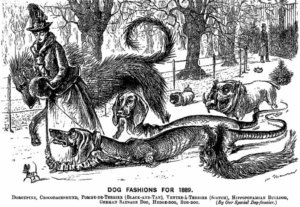
In the 20th and 21st centuries, however, we’ve started recognizing that some of these shapes, so different from the original dog shape, might be associated with physical disorders that can affect canine welfare. Our choices about how a dog looks can affect their capabilities, such as their ability to move comfortably, breathe, see, or hear. This review article (currently available as a preprint, and in the process of being submitted to a scientific journal) collects in a summary the extensive research about the different shapes that dogs can be, and how those shapes can affect a dog’s health or well-being.
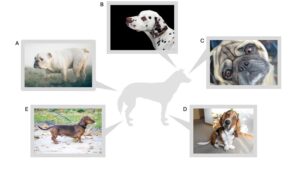
This figure from the paper provides some examples of extreme shapes that can adversely affect dogs – A. curly tails, associated with misshapen vertebrae and resulting back problems; B. extreme white coat color, associated with deafness; C. flat faces, associated with problems with breathing, eyes, skin, and digestive system; D. “wrap-around” front legs, associated with leg pain; E. chondrodystrophy (part but not all of the reason some breeds have such short legs), associated with extremely painful back problems.
Size
Dogs have the widest size range of any mammal, from the miniscule Chihuahua (which can stand under 6in/15cm tall and weigh just 3.5lbs/1.5kg) to the Irish Wolfhound (up to about 37in/94cm tall) and Mastiff (up to about 231lbs/105 kg). The weight difference is especially impressive – a Mastiff might weigh 66 times as much as a Chihuahua. We don’t know what the “best” size or weight is for a dog, though we might define “best” as “associated with the longest lifespan and healthspan.” Looking at village dogs, who mostly breed without human intervention, we see that they tend to be around 25-50 pounds (10-20 kg).
Generally, smaller dogs live longer than larger dogs – between the smallest and the largest we see a lifespan difference of about 4.5 years.
Larger dogs’ mortality may have to do with the rapid growth necessary to reach that large size. This rapid growth may predispose them to cancer, a relationship particularly clear in the case of osteosarcoma, a cancer that typically appears in the long leg bones. For large breeds with high risk of cancer, decreasing their size could be a very effective prevention measure.
Size affects the risk of a variety of disorders:
|
Large dogs |
Small dogs |
|
|
Orthopedic disorders |
Hip dysplasia Elbow dysplasia Cranial cruciate ligament tear |
Patellar luxation |
|
Cardiac disease |
Dilated cardiomyopathy |
Mitral valve disease |
|
Energy regulation |
Overheat easily |
Low blood sugar |
|
Giving birth |
Problematic for both very large and very small dogs |
|
Most of the studies looking at these problems focus on problems associated with specific breed, but the authors of this article suggest that it could be helpful to look across breeds (and mixes) to find direct relationships between size and various disorders. How big can a dog be and still be healthy? How small? What’s the size range that we should aim for? These are questions we haven’t systematically asked yet.
Head shape
Flat-faced (brachycephalic) dogs like the French Bulldog, English Bulldog, and Pug have recently become extremely popular. The breathing issues related to a flat face are fairly well known; these issues stem from narrow nostrils, thick tongues and soft palates, as well as bones in the skull (nasal turbinates) that may push against the airway. The flat face is associated with many more problems than just breathing issues, however. Chihuahuas and Cavalier King Charles Spaniels are examples of breeds with domed heads that lead to pressure on the brain and resulting pain and neurological issues (Chiari malformation and syringomyelia). Other breeds typically have eye problems – the flat face means the eyes bulge out and are not well protected, leading to painful ulcers. In fact, flat-faced dogs may be almost 12 times more likely to have ocular ulcers. Narrow ear canals lead to common ear infections – an ear infection is the most common diagnosis of English Bulldogs. Giving birth naturally is nearly impossible for many of these breeds; 95% of English Bulldogs may be born by Caesarean section. Why are these dogs so popular? Can we retain their characteristic look, yet have enough muzzle to breed away from these issues? How much muzzle is enough?
Leg length
The very short legs in breeds like the Dachshund and Basset Hound are in large part due to a disorder called chondrodysplasia. Very short legs don’t appear to inherently cause health issues, but they are commonly also curved or bowed, which can cause pain. (For example, the Basset breed standard specifically calls for bowed front legs.) This relationship has been discovered relatively recently and more research is needed to better understand why some short-legged dogs have straight (and healthy) legs and others have a distinct curve or bow.
Chondrodystrophy also contributes to short legs (though not as much as chondrodysplasia does). This disorder causes many of the soft padded discs between a dog’s spinal bones to be hard, leading to greatly elevated risk (and at a much younger age) of intervertebral herniation, when part of the spinal cord is pushed out of where it should be, causing intense pain and sometimes paralysis. On the one hand, as this mutation doesn’t dramatically shorten the legs, breeding away from it might not cause major effects on how a breed looks – you can still have a dog with quite short legs, even without this mutation. Unfortunately, many breeds have almost no dogs without the mutation (it’s at a frequency of 94% in Dachshunds, 99% in Beagles, and 91% in Cocker Spaniels), meaning that a practical program to breed it out would be challenging to develop. The breeds which have this mutation can be surprising – many people don’t think of Beagles or Cockers as short-legged, for example.
Skin folds
Many dogs of flat-faced breeds also have deeply folded skin over their face (the English Bulldog and Pug are good examples). This sets the dog up for skin infections deep in the folds, where moisture is trapped, and in fact English Bulldogs have 49 times the risk of skin fold infections – that number may actually be higher, as skin deep at the bottom of a fold may be hard to see and so these infections are probably under reported. Prominent facial folds may also rub against a dog’s eyes – another reason why flat-faced dogs are so likely to develop eye ulcers. Shar-Peis are not extremely flat-faced, but have been specifically bred to have skin folds all over their bodies, and also suffer from skin fold infections.
Tail length and curliness
Very short and curly (“screw”) tails are associated with misshapen vertebrae, which may directly cause neurologic disorders. Additionally, vertebral problems from screw tails are associated with bent backs, which are then associated with intervertebral disc herniation. So, while the Dachshund is the poster child for disc herniation, the French Bulldog actually herniates on average two years earlier than a Dachshund, due to its combined risk factors of chondrodystrophy and screw tail. Skin folds around screw tails can, again, cause skin fold infections. Finally, simply having a short tail may be a problem, as dogs use their tails to communicate with each other, and having a nub may limit that ability.
Coat
Dog coat color and length is one of the most visually striking ways we recognize a breed. (Imagine a long-haired pit-bull type dog – for most people, those two characteristics are not compatible.) Dogs come in a lot more coat colors, patterns, and types than wolves, and most of these mutations have no welfare issues. However, a few are problematic.
The Dalmatian is a striking combination of white color and distinct black spots. The white increases the risk of deafness – about 22% of Dalmatians are deaf in one ear, and about 8% are deaf in both ears (and therefore cannot hear at all). Breeding for dark patches on the ears reduces this risk, but the Dalmatian breed standard discourages this. The beautiful spotted pattern is closely tied to a disorder that causes urinary tract stones, a painful disease that may require dogs to eat only certain kinds of foods. It’s not clear if the mutation for this disorder can be entirely separated from the spotting pattern, as lines of Dalmatians without the disorder have slightly more frosted looking spots, but more research to investigate could help encourage Dalmatian breeders to breed away from the mutation.
Another striking pattern, merle, is associated with deafness and vision problems (particularly in dogs with two copies of the merle allele, but to a lesser extent in those with one copy). Dilute coat color – dilution of black to “blue” and brown to “silver,” for example – is associated with loss of hair and skin problems. Yet these mutations are being introduced into new breeds, notably merle into French Bulldogs and dilute into Labrador Retrievers.
Less common but also problematic is the ridge of the Rhodesian Ridgeback, a line of hair along the spine that grows in the reverse direction. Ridged dogs are at increased risk of a developmental disorder in which the skin and the nervous system don’t completely separate along that ridge. Hairless dogs, such as Chinese Cresteds, commonly have misshapen or missing teeth due to side effects of the mutation that causes them not to grow hair.
Discussion
What does a physically healthy dog look like? The list of issues in this review tell us some ways a healthy dog probably does not look. Most of the problems described here are linked to extreme morphologies – shapes that markedly differ from the generic “dog” shape. How far can we go in breeding dogs that have characteristic and beloved breed appearances without compromising their welfare? We don’t really know, and this paper calls for more research to better find out. Though recent legislation, mostly in Europe, has aimed at restricting the types of dogs breeders are allowed to produce, puppy buyers are also driving the demand for many of these extreme shapes.
We have bred dogs in these shapes, sizes, and colors in some cases for almost two hundred years. For much of that time we didn’t know (or didn’t know for sure) that our choices caused any problems for the dogs themselves. Now we have extensive evidence that, in fact, dogs are suffering because of our preferences for how they look. As a community of people who love dogs, it’s time to come together and find a way forward to make change.
This article has been signed by veterinarians and researchers of canine health and welfare, who join the authors in calling for change.