Podcast
The Flatcoat Conservation Project – with Jess Sedivy Gunderson and Xan Latta
Apr
Jessica Perry Hekman:
Welcome to the Functional Breeding Podcast! I’m Jessica Perry Hekman and we’re here to explore what goes into breeding dogs for functional health – both behavioral and physical.
This podcast is brought to you by the Functional Dog Collaborative, an organization founded to support the ethical breeding of healthy, behaviorally sound dogs. The FDC provides educational, social, and technical resources to breeders of both purebred and mixed breed dogs. You can find out more at functionalbreeding.org or in the Functional Breeding Facebook group, which we work hard to keep friendly and inclusive.
If you’d like to support the podcast, you can find us on Patreon—there’s a link in the show notes.
Over the next few months, you’ll be hearing from Jess Sedivy Gunderson, a Flat-Coated Retriever breeder, cytologist, and Vice President of the FDC board. Jess will be stepping in as interim host while I take a little break.
Much like I have, Jess will be talking with guests about how to breed dogs for function and for health—both behavioral and physical—and I’m really excited for the FDC community to get to know her better.
We’ll also be sharing some crossover episodes with other podcasts we enjoy, along with replays of a few favorite episodes from our archive.
Thanks for listening—I hope you enjoy getting to know Jess, and I’ll be back as soon as I’m able.
Jess Sedivy Gunderson:
Hi everyone, I’m Jess and I’m really excited to be guest hosting the Functional Breeding podcast. But before you hear from me as a host, we thought you might like to get to know a bit more about me first. So today, Sarah Stremming, whom you all know and love, will interview me alongside and my friend and Flatcoat Conservation Project co-founder, Xan Lotta today. We sit down to talk about how we got started as breeders, our project, and our passion for Flatcoated Retrievers. Enjoy the episode!
Sarah Stremming (she/her):
Hey everyone, it’s Sarah Stremming, host of Cogdog Radio. It’s my pleasure to guest host the Functional Breeding Podcast this week.
Genetic rescue is a strategy used in conservation breeding to restore health and viability in populations that have become too inbred by introducing new genetic variation. The goal is to improve overall fitness—things like fertility, disease resistance, and what breeders often call vigor.
In purebred dogs, this isn’t a new idea. It reflects the very origins of how breeds were developed through thoughtful outcrossing, followed by careful selection for type and temperament over generations. But modern purebred systems often operate within closed registries where no new genetic material can enter. When those systems begin to limit a breed’s long-term health, breeders are faced with a difficult question: do we preserve the system, or the dogs themselves?
My guests today are Xan Latta and Jess Sedivy Gunderson, co-founders of the Flatcoat Conservation Project, who are working to explore what that choice looks like in practice.
So Jess, for our listeners who are not familiar with flat-coated retrievers, tell us a bit about the breed.
Jess Sedivy:
Thank you for having us, Sarah. We’re excited to be here to talk about our project and to talk about flatcoats.
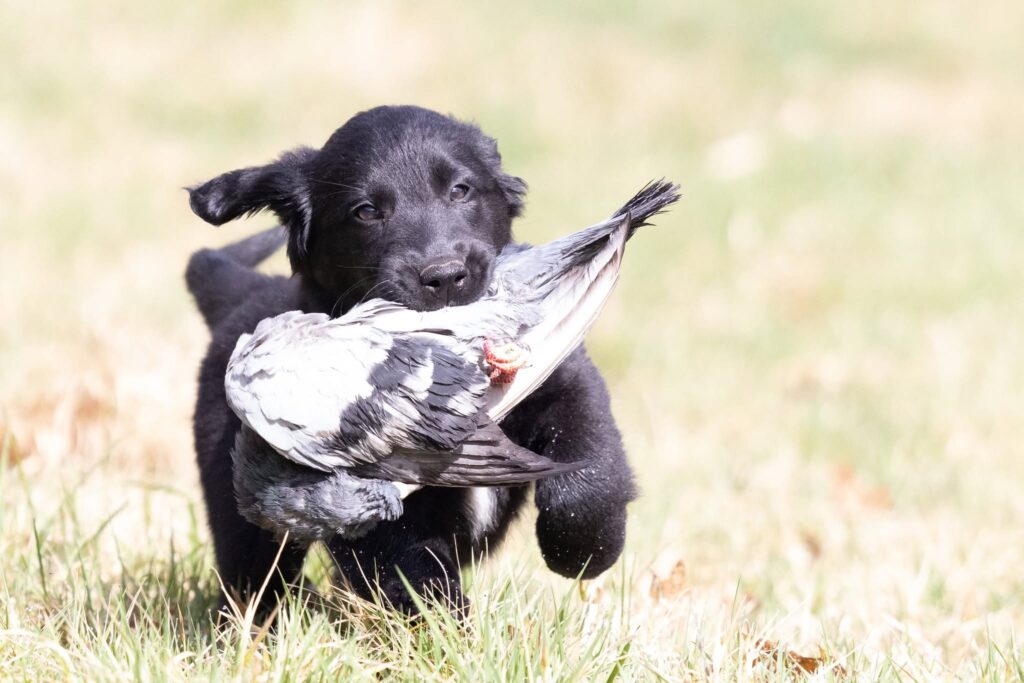
For those listening who have never met a flat-coated retriever or aren’t familiar with the breed, they’re often called the “black golden retriever” or the “long-haired black Lab.” They’re a style of retriever that’s a little bit different from some of the other retrievers.
The thing about flatcoats that has always resonated with me is that they are a very joyful dog. They’re happy, carefree, and approach life with a lighthearted attitude—which I think is good for someone like me, because I can be a very serious person. I’ve often wondered who I would be without flatcoats.
They also make a really great personal hunting companion, and they’re undeniably beautiful and very loving dogs.
Xan:
Yeah, I think just to add to that, I really value the adaptability and versatility of the breed. They can adapt to a wide range of households. They can relax on the couch, but they’re always eager to say yes to adventure.
So they’re dogs that can thrive in serious hunting homes, but also as great family companions and adventure buddies.
Jess Sedivy:
Yeah, and I think Xan and I have talked about how we’ve actually been a little disappointed that the breed has never had a chance to become more popular in North America. The numbers are still fairly small, but they really do make wonderful companions and excellent house dogs.
Sarah Stremming (she/her):
So before the Flatcoat Conservation Project, what did your life in flatcoats look like beyond just “they’re lovely and joyful and great hunting companions”?
Jess Sedivy:
My family was involved in purebred dogs, so I started quite young. I got my first flatcoat when I was 17.
When I first got into the breed, I was very much a traditional person. I joined the club right away, followed all the publications, read the newsletters, and signed the code of ethics every year with full intent to follow it.
I competed in obedience and field work. I always trained and handled my own dogs—which I was proud of, even if you could argue it wasn’t always to their benefit.
At the same time, they were my best friends. They were the dogs I came home to after a day of college classes or early in my career. I was deeply involved in dog sports and extremely committed to the mission of the Flat-Coated Retriever Society of America. I was very much an insider—and Xan definitely was too.
Xan:
Yeah, I was deeply involved in the breed as well. I participated in both showing and working activities—hunt tests, obedience, agility.
I became what people would describe as a “student of the breed.” I traveled internationally to study dogs, attended world dog shows and Crufts, and tried to understand differences between breeders and breeding goals.
I also served on the National Breed Club Health Committee for a period of time, so I was very embedded in both flatcoat culture and purebred dog breeding in general.
Sarah Stremming (she/her):
So the reality is that both of you are deeply established in this breed. This isn’t people just dropping in and saying, “I think there’s a problem.”
What kind of breeder did you aspire to be when you were part of the breed club?
Jess Sedivy:
When I started breeding, I aspired to be the type of breeder most people do. I wanted to breed dogs that could do everything—win championships, perform in the field, and succeed in various dog sports.
I wanted to breed dogs that were versatile for families—whether that meant agility through 4-H or just being great companions. I wanted healthy dogs, long-lived dogs, and dogs that could live happily in an average household.
I never pressured puppy homes into competition. I supported them regardless of their goals. To me, a family hiking every weekend was just as valuable as someone competing at a high level.
One thing I didn’t aspire to be—which may sound odd now—was a leader in the club. I didn’t seek positions or visibility. That’s changed quite a bit over time.
Xan:
I was similar. I focused heavily on the working side of the breed and getting people engaged in field work.
My breeding goals centered on producing adaptable, versatile dogs—the qualities that made me fall in love with the breed.
Sarah Stremming (she/her):
So what problems were you seeing in the breed that the community was struggling to solve?
Jess Sedivy:
Flat-coated retrievers disproportionately die of cancer—particularly hematopoietic cancers like histiocytic sarcoma, hemangiosarcoma, and lymphoma.
Even when I got into the breed in 1996, cancer was a known issue. But I was naive—I thought I could manage it through diet, environment, or care practices.
I didn’t fully understand how deeply entrenched the problem was.
Xan:
To put numbers to it, about 70% of dogs are dying from cancer. Average lifespan is around 9–10 years, sometimes lower.
We’re seeing dogs die young from aggressive, incurable cancers. At the same time, breeders have done a good job managing testable conditions like hip dysplasia and genetic diseases.
But it doesn’t matter if dogs are still dying young from cancer.
Jess Sedivy:
Exactly. The community has made progress where tools exist—orthopedics and structural health—but those improvements are around the edges of the main issue, which is cancer.
Sarah Stremming (she/her):
When did you start questioning the status quo?
Jess Sedivy:
It built over time, but a breaking point came around 2013–2014.
A breeding I was involved in resulted in the loss of a litter of nine puppies, and the dam died at four years old from histiocytic sarcoma. That was devastating.
I realized we weren’t making progress. Even highly respected breeders weren’t solving the problem.
At that point, people either accept it or leave the breed—and many have left.
Xan:
I understood early on that closed gene pools concentrate problems, but I thought I could work around it.
I tried multiple strategies—breeding for longevity patterns, consulting experts—but nothing worked.
Eventually, the repeated losses become too much.
Sarah Stremming (she/her):
Was there resistance when you started asking questions?
Jess Sedivy:
Yes—but more than resistance, there was resignation.
People had accepted the problem. When I brought up outcrossing, the response was always that it would never happen.
It felt very hopeless.
Xan:
There’s awareness of the issue, but no belief in a solution. People are waiting for science to fix it—but the solution has been in front of us.
Jess Sedivy:
Science showed us the way a long time ago—we just have to be willing to take it.
Sarah Stremming (she/her):
So what is the hardest part of doing this work that people don’t see?
Jess Sedivy:
The time commitment. When we’re quiet on social media, it’s because we’re working—meeting with researchers, reviewing data, collaborating on documents.
It’s become a part-time job, and there’s also an emotional toll—especially when relationships change or support isn’t there.
Xan:
There’s also a huge learning curve. There isn’t a readily accessible body of knowledge on population genetics in the purebred dog world, so we had to build that understanding ourselves.
Sarah Stremming (she/her):
What does success look like for the Flatcoat Conservation Project?
Jess Sedivy:
Success means we’re still here in 20 years, with a growing community.
It means being able to hand someone a puppy without fearing they’ll lose that dog early. It means lifting the emotional burden that flatcoat owners currently carry.
Xan:
We’ve already seen some success. We have outcross puppies on the ground, and I felt confident placing them into homes.
Long-term success is about meeting our goals and seeing broader adoption within the breed community.
Sarah Stremming (she/her):
What could the breed look like in 20–30 years if things go right?
Jess Sedivy:
Healthier. Possibly slightly different, but still recognizable.
If the broader community remains open-minded and some of these dogs integrate into the population, we could see a meaningful shift.
Xan:
The goal is simple: dogs that look and act like flatcoats but live long, healthy lives. That’s absolutely attainable.
Sarah Stremming (she/her):
What would you say to flatcoat enthusiasts who are hesitant?
Jess Sedivy:
I understand the hesitation. It’s hard to imagine change.
But I’d encourage people to stay open-minded and follow the project. It will be transparent and science-driven.
Sarah Stremming (she/her):
All right, I think that’s a great place to wrap up. Thank you both so much for having this conversation with me today.
Jess Sedivy:
Thank you for having us, Sarah. We appreciate it.
Xan:
Thanks so much, Sarah.
Sarah Stremming (she/her):
And thanks everybody for listening.
Jessica Perry Hekman:
Come join us in the Functional Breeding Facebook group to talk about this episode or about responsible breeding practices in general. To learn more about the Functional Dog Collaborative, visit functionalbreeding.org.
This episode was produced and edited by Charmaine Swan with production support from Jess Sedivy Gunderson.
If you’d like to support the show and FDC itself, you can find us on Patreon—check the link in the show notes.
Enjoy your dogs!